
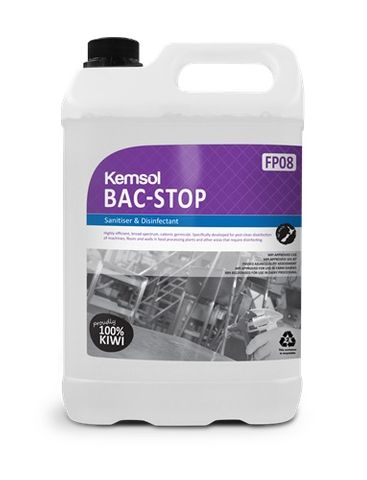
Disinfectant-Bac Stop Sanitiser 5L
Description
Sanitizer & Disinfectant
Highly efficient, broad spectrum, cationic germicide. Specifically developed for post-clean disinfection of machines, floors and walls in food processing plants and other areas that require disinfecting.
Directions
MPI Approved C43 & Direct Inspected MPI Multi-site Facilities
Open hard surface sanitizing: use at a ratio of 1:100 (10ml per litre, 1% soln) to 1:200 (5ml per litre, 0.5% soln, 500PPM).
Foot baths: use at a ratio of 1:50 (20 ml per litre, 2% soln, 2000PPM). Test strip verification recommended to ensure min QAC level of 400PPM is maintained.
Food plant area hard surface foam sanitizing: use at a ratio of 1:100 (10ml per litre, 1% soln).
Mould and mildew control: use at a ratio of 1:20 - 1:5 (50-200ml per litre, 5-20% soln).
Clean the surface to be disinfected. Dilute with water. Water blast (preferably with a foaming nozzle) or brush on machine or surface to be disinfected. Rinse off with water. May be used at 1:200 dilution as a “no rinse” sanitizer in fish processing applications.
In the case of operators that only process fish, rinsing after application of this product is not necessary, however food contact surfaces must still be thoroughly drained to minimise residues. For all other operators, food surfaces must be thoroughly rinsed with potable water before production starts.
A lower dilution rate may be used in accordance with a site’s specific stated QAC standards, where a verifiable testing program has been substantiated.
General non-food contact surfaces may be used in a no-rinse capacity.
May also be used to sanitize open work surfaces such as work tables that contact food, providing these can be rinsed and drained completely, in order to prevent pooling of detergent residues. Because the product contains QAC sanitizer, do not use as a Clean-In-Place (CIP) cleaner for enclosed systems, as pooling in such systems may lead to contamination by detergent residues. Incidental food contact surfaces should be wiped with a clean, damp cloth or paper towel.
THIS IS A DANGEROUS GOODS PRODUCT, LOCAL DELIVERY ONLY